
FIELD GUIDE | TABLE ROCK AND THE WIDER UPSTATE
Get to know what lives beneath the surface
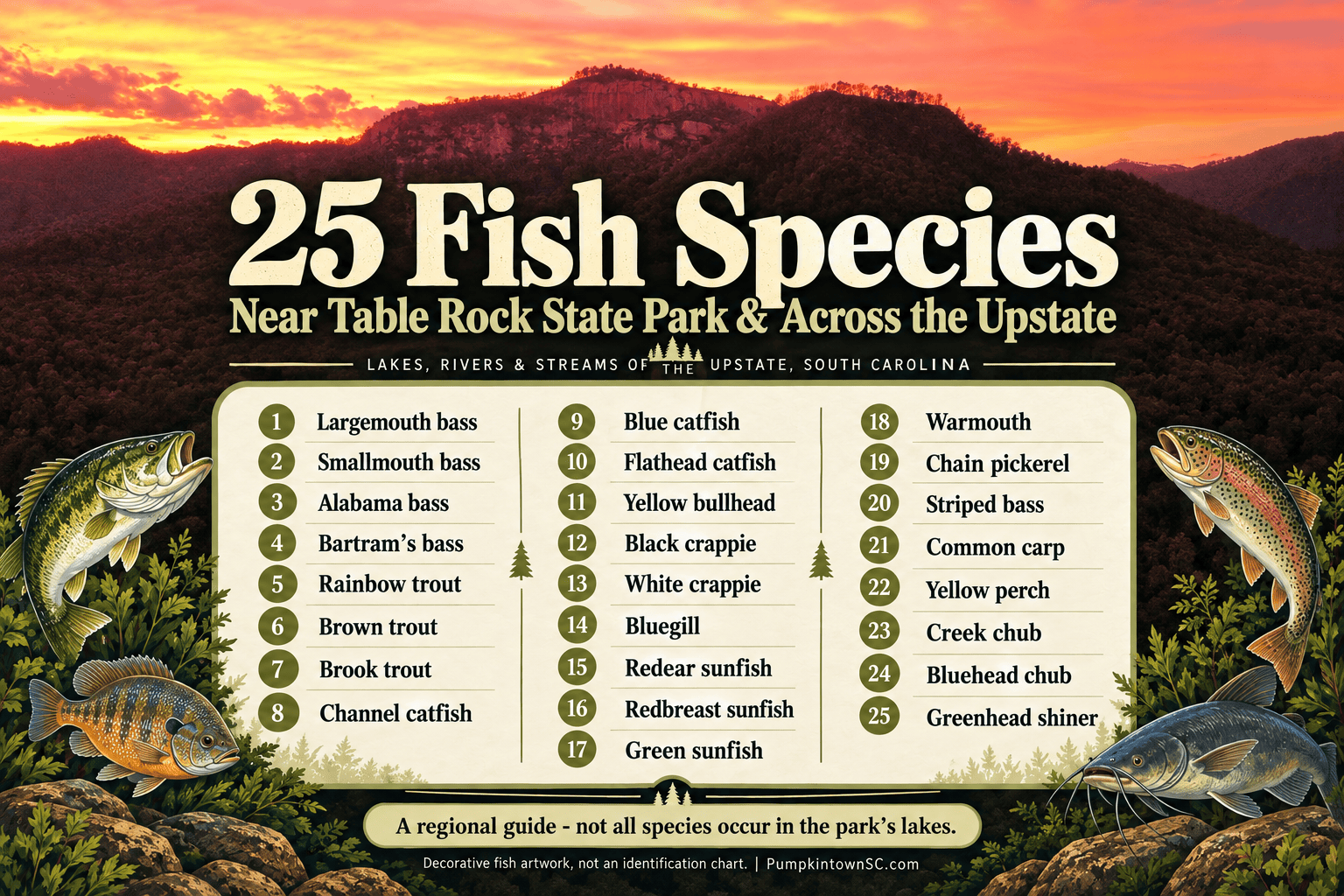
A bream beside a fishing pier, a trout holding in cold current, and a bass beneath a reservoir dock belong to very different underwater neighborhoods. Around Table Rock, learning the fish begins with learning the water. Here are 25 species to know across the park area and the wider northwestern Upstate.
Table Rock State Park is a useful starting point for freshwater fishing, but its two lakes are only part of the regional picture. Beyond the park, the landscape opens into the Jocassee and Keowee reservoirs, mountain streams, and the larger Lake Hartwell fishery farther away. Those waters share a region without sharing an identical fish community.
This is a regional identification and natural-history guide, not a survey proving that all 25 species live inside Table Rock State Park. Some entries have named local waters in SCDNR sources; others have broader statewide or foothill ranges. Those distinctions matter when deciding what you might see, where to fish, and how much confidence to place in an identification.
Start with the right kind of water
| Setting | Useful starting point | What the evidence tells us |
|---|---|---|
| Inside Table Rock State Park | Lake Oolenoy and Lake Pinnacle | The park lists bass, bream and catfish; it does not publish a complete species inventory on its visitor page. |
| Nearby large reservoirs | Lake Jocassee and Lake Keowee | Jocassee has rainbow and brown trout; SCDNR lists smallmouth bass in both lakes. Introduced Alabama bass complicate native bass conservation. |
| Cold mountain streams | Appropriate waters in Pickens, Oconee and Greenville counties | Trout distribution depends on temperature, habitat and stocking. A scenic creek is not automatically trout water. |
| Wider regional outing | Lake Hartwell | A separate reservoir trip, including striped bass fishing; not a lake within Table Rock State Park. |
| Small foothill creeks | Callahan Creek at Poinsett Bridge Heritage Preserve | SCDNR names creek chub, bluehead chub, and greenhead shiner. This drainage is separate from the Savannah system. |
For locations and trip planning, continue with our guide to fishing spots near Table Rock or the Upstate mountain fishing guide. The list below focuses on the fish themselves.
Black bass: familiar fish with a changing story
1. Largemouth bass
The long upper jaw extending behind the eye is a useful clue on an adult largemouth. Its sides commonly carry a dark horizontal band. SCDNR places it in warmwater habitats statewide, including ponds, lakes and slower river sections. Think of cover and quieter water rather than treating every cold mountain creek as bass habitat. SCDNR reference.
2. Smallmouth bass
Bronze coloring, darker vertical markings and a shorter jaw help distinguish a smallmouth from a largemouth. SCDNR specifically lists lakes Jocassee and Keowee in its South Carolina range. This introduced sport fish belongs in the regional reservoir story; its presence in those lakes is not evidence that it inhabits either park lake. SCDNR reference.
3. Alabama bass, often called spotted bass locally
The name “spotted bass” appears in older guides and everyday fishing conversation, but SCDNR research identifies introduced Alabama bass in the Savannah basin reservoirs. They have spread from unauthorized introductions into Keowee and Russell and hybridize with native bass. Treat a spotted-looking bass as an identification question, especially when conservation or a record application depends on the answer. SCDNR reference.
4. Bartram’s bass
One of the region’s most distinctive fish received a formal species description in 2025. Bartram’s bass, Micropterus pucpuggy, is restricted to the Savannah River drainage shared by South Carolina, Georgia and North Carolina. Older sources call it redeye bass. Its story includes native stream habitat and threats from hybridization, rather than a promise of abundant pure fish in every reservoir. SCDNR reference.
SCDNR’s native bass conservation account documents substantial losses in Savannah basin reservoirs. Red eyes alone do not establish that a bass is Bartram’s, and a photograph may not settle hybrid ancestry. The new name helps explain why an older field guide and a current research article can describe the same regional fish differently.
Trout: follow the cold water
5. Rainbow trout
A pinkish band along the side and dark spotting, including on the tail, are useful rainbow clues. SCDNR lists Lake Jocassee and mountain streams in Pickens, Oconee and Greenville counties. Both stocking and self-sustaining populations contribute to South Carolina trout fishing, so seeing a rainbow does not by itself reveal whether that fish was raised in a hatchery. SCDNR reference.
6. Brown trout
Brown trout often show dark spots and red spots against olive or golden coloring, although hatchery and wild fish can look different. Their documented regional range includes Lake Jocassee and mountain streams in the three northwestern counties. A deep, cold reservoir fishery and a small stream outing require different planning even when the target species is the same. SCDNR reference.
7. Brook trout
Pale spots against a dark body and white leading edges on the lower fins help separate brook trout from the other trout in this guide. SCDNR lists mountain streams in Oconee, Pickens and Greenville counties and describes a preference for small, cool, well-oxygenated water. Native brook trout are part of the headwater story, not a fish to assume is present throughout every named trout river. SCDNR reference.
Use our regional trout-fishing guide to begin planning, then check the regulations for the exact water and section. Stocking, wild populations and special management rules are separate questions. A roadside stream view cannot answer all three.
Catfish: look beyond the whiskers
8. Channel catfish
A deeply forked tail and dark spots on smaller fish are useful clues, but the spots can fade as fish grow. Channel catfish have a statewide range and use creeks, rivers, ponds and reservoirs. The park confirms catfish fishing without naming each species, so that general description should not be converted into a complete catfish checklist for its lakes. SCDNR reference.
9. Blue catfish
Blue catfish also have a forked tail, making a casual glance insufficient to distinguish them from channels. SCDNR describes an unspotted body and a range covering almost every South Carolina drainage. Include them in the broader reservoir and river picture, without assuming that a small park lake offers the same fishery as a large impoundment. SCDNR reference.
10. Flathead catfish
A broad, flattened head, projecting lower jaw and relatively square tail help set the flathead apart from fork-tailed catfish. SCDNR places it in several drainages, including the Savannah system in the Piedmont and Coastal Plain. This is a broader regional fish, not a documented promise for Pinnacle Lake or Lake Oolenoy. SCDNR reference.
11. Yellow bullhead
The pale chin barbels and rounded or nearly straight tail are useful starting points for recognizing this smaller catfish. SCDNR lists a statewide range and describes pools with soft bottoms in small and medium rivers as typical habitat. Bullheads deserve a place in the guide even though fishing conversations often focus on their much larger relatives. SCDNR reference.
Crappie: two species, not two color phases
12. Black crappie
Irregular dark mottling and usually seven or eight dorsal spines are key identification clues. SCDNR lists black crappie statewide, with lakes, reservoirs and backwaters providing suitable habitat. Its preference for clearer water does not establish a population in every clear lake, and mountain streams are not the usual crappie setting. SCDNR reference.
13. White crappie
Dark markings tend to form vertical bars rather than the scattered pattern associated with black crappie. Both species have broad South Carolina ranges, and white crappie tolerate more turbid conditions. Color alone is an unreliable shortcut: examine the pattern and use an identification reference instead of deciding that a pale fish must be a white crappie. SCDNR reference.
Sunfish and bream: small fish worth knowing
“Bream” is a familiar umbrella term, not a single species name. The details of the gill-cover flap, mouth, fins and body pattern help separate the sunfish below. Breeding colors and individual variation can change their appearance, so use more than one feature.
14. Bluegill
A small mouth, dark gill-cover flap and dark patch near the rear of the dorsal fin are useful bluegill clues. This widespread South Carolina sunfish is a good species to learn before tackling more difficult identifications. Watch the combination of shape and markings rather than expecting every individual to look vividly blue. SCDNR reference.
15. Redear sunfish, or shellcracker
A red or orange edge on the dark gill-cover flap gives the redear its common name. Its snail-feeding habits explain “shellcracker.” SCDNR lists the fish statewide in a variety of slower-water habitats. The colored flap is helpful, but compare other features rather than using one small patch of color as your entire identification. SCDNR reference.
16. Redbreast sunfish
The long black extension of the gill cover is a particularly useful feature. An orange or reddish breast adds color, with appearance differing between males and females. This sunfish belongs in a regional river-and-stream discussion as well as the broader bream family; it should not be confused with a bluegill simply because both have a dark gill flap. SCDNR reference.
17. Green sunfish
A comparatively large mouth and blue-green markings along the cheek and sides help distinguish a green sunfish. SCDNR places it mainly in the Blue Ridge and Piedmont foothills, making it a particularly relevant fish for this guide. Its body is less deep than the familiar rounded bluegill silhouette. SCDNR reference.
18. Warmouth
The warmouth combines a large mouth with a mottled brownish body and darker lines radiating from the eye. SCDNR lists it statewide and describes slow-water habitats with submerged cover. Its appearance can suggest a small bass at first glance, which is a good reason to check the whole fish rather than relying on mouth size alone. SCDNR reference.
Other fish of lakes and slower water
19. Chain pickerel
An elongated body, pointed duckbill-like snout and chain-patterned markings make this predator distinctive. SCDNR describes a broad statewide range apart from the Broad River system, with vegetated, slow-water habitats preferred. It belongs in the regional freshwater picture, but a statewide range statement is not a verified sighting at an individual park lake. SCDNR reference.
20. Striped bass
Dark lengthwise stripes run along a silvery body. For a named regional reservoir, SCDNR lists Lake Hartwell; this guide does not repeat the original article’s unsupported Keowee claim. A Hartwell striper trip is a separate outing from fishing beside Table Rock. The fish is also different from the hybrid striped bass commonly discussed alongside it. SCDNR reference.
21. Common carp
The barbels at the mouth and large scales help distinguish common carp from some other large freshwater fish. SCDNR lists a statewide range and slower, warmer water with soft bottoms as typical habitat. “Carp” can refer to several different fishes, so the species name matters when describing a catch or discussing fish movement between waters. SCDNR reference.
22. Yellow perch
Yellowish sides crossed by dark vertical bars make this perch recognizable. SCDNR lists a statewide range across streams, rivers and reservoirs. It is a distinct species from white perch and should not be treated as another name for bream. This entry describes regional range rather than promising a productive yellow-perch spot inside Table Rock. SCDNR reference.
Why hybrid striped bass are not one of the 25
Hybrid striped bass are an important sport fish, but they are crosses between striped bass and white bass, not a separate species. SCDNR’s regional fishing reports discuss stripers and hybrids at Hartwell. They are worth knowing about without counting a hybrid as a twenty-sixth species or using it to fill a 25-species list.
Small stream fish: another side of the foothills
The last three fish come with a specific nearby regional source. SCDNR’s Poinsett Bridge Heritage Preserve description names them in Callahan Creek, a headwater tributary in the Saluda drainage. That makes them useful examples of foothill stream diversity, not evidence that all three occur in Carrick Creek or the park’s lakes.
23. Creek chub
Creek chub reminds us that a stream fish community is more than the fish anglers target. SCDNR specifically includes it in the small Callahan Creek community. If you see a small fish in shallow water, “minnow” is a starting description, not a completed identification. Leave room for uncertainty instead of forcing every fish into a familiar sport-fish name. SCDNR reference.
24. Bluehead chub
SCDNR also names bluehead chub at Callahan Creek. Its educational materials describe how bluehead chub build gravel nests used by other fishes, connecting one small species to the reproduction of several neighbors. A patch of gravel in a stream can therefore be living habitat rather than something to rearrange for a photograph. SCDNR reference.
25. Greenhead shiner
Greenhead shiner is the third species explicitly named in the preserve’s creek description. Including it broadens the guide beyond catches measured in pounds. Small creek fishes are part of the region’s diversity in their own right, and identifying them may take a more specialized reference than a general bass-and-trout chart. SCDNR reference.
The bluehead chub’s nesting role is explained in SCDNR’s keystone-species educational material. Observe creek habitat from an allowed route, respect land boundaries, and do not assume a species record grants fishing or collection permission.
Plan a fishing visit at Table Rock
The official park visitor page lists fishing for bass, bream and catfish in 67-acre Lake Oolenoy and 36-acre Lake Pinnacle. Oolenoy has a fishing pier the park describes as accessible to people with disabilities. These practical features are more useful for planning a first visit than an unverified claim that every fish on a regional list lives beneath that pier.
Oolenoy allows electric trolling motors and paddle-powered boats, with private boats launched at the ramp rather than from the shoreline. Gas motors are prohibited. Pinnacle has rentals and separate launch restrictions. Our Table Rock boating guide covers the arrangements; check current park information before bringing equipment.
Identify first, then decide what to keep
Consult SCDNR’s current fishing regulations for licensing, species limits, tackle rules and requirements for the particular water. The same species can be subject to different rules in different places. For reservoirs that cross a state boundary, confirm which rules apply to your location rather than assuming a South Carolina summary resolves every situation.
If you intend to eat a catch, use the SCDES fish-consumption guidance and advisory map for the water and species. Clear water and a healthy-looking fish do not establish consumption safety. An unlisted waterbody can mean insufficient sampling or data, so absence from an advisory list is not automatically a clean bill of health.
SCDNR’s native bass conservation guidance asks anglers not to release fish into waters other than where they were caught. Moving a fish can spread an introduced species or its genes into a different population. The conservation story around Table Rock is a practical reminder that a fish can be desirable to catch and still cause problems when moved.
Questions about fish near Table Rock
Are all 25 species found inside Table Rock State Park?
No. This is a regional guide covering the park area and the wider northwestern Upstate. The park visitor page lists bass, bream and catfish in its lakes, but does not provide a complete species-by-species inventory.
What does bream mean?
Bream is a common term for several sunfish. Bluegill, redear, redbreast, green sunfish and warmouth are distinct species, not interchangeable names for one fish.
Is hybrid striped bass a separate species?
No. It is a striped bass-white bass cross. It can be an important part of a fishery without belonging in a count of distinct species.
Is Bartram’s bass the same name I saw as redeye bass?
Older South Carolina materials describe the Savannah drainage fish as redeye or Bartram’s bass. SCDNR announced its formal description as Bartram’s bass, Micropterus pucpuggy, in September 2025. Older range and taxonomy summaries need to be read in that context.
Can a red eye or one body marking identify a fish?
Use several features and a reliable reference. Colors vary, different species share features, and bass hybridization can complicate identification. A red eye alone does not prove a fish is Bartram’s bass.
Where should I check before fishing or keeping a catch?
Use the current SCDNR regulations for your exact water, the land manager’s access information, and SCDES consumption guidance if you plan to eat fish. This species guide does not replace those checks.
Look more closely on your next visit
The fish worth noticing are not always the largest ones. A sunfish near shore, a trout in a shaded pool, and a tiny shiner in a foothill creek each tell you something about the water around them. Learn a few reliable features, keep the location in mind, and let an uncertain identification remain uncertain until you have a better reference.


