

Walk through Table Rock State Park after a stretch of warm, rainy weather, and you may notice something that is easy to overlook during drier parts of the year. Mushrooms seem to be everywhere.
They can appear beside the trail, underneath leaves, on fallen logs, and even from tiny cracks in decaying wood. Some last only a few days while others remain on trees and logs for months.
The forests around Table Rock provide nearly perfect mushroom habitat. Shade, summer humidity, abundant rainfall, and large amounts of fallen wood create an environment where fungi thrive.
During a summer hike through the park, we photographed several very different mushrooms within a relatively small area. They are a good example of how much fungal diversity can hide along a familiar trail.
Important: Mushroom identification from photographs alone can be difficult, and many species look remarkably similar. The identifications below are intended as general field observations rather than confirmation that a mushroom is edible. Never eat a wild mushroom based solely on a photograph, website or phone app.
The Tall Mushrooms That Are Hard to Miss

One of the most impressive mushrooms we encountered was also one of the tallest.
Its long patterned stalk held a broad grayish cap well above the surrounding vegetation. Mushrooms with this general appearance can occur in several groups, including Amanita and other large woodland mushrooms.
The specimen is especially interesting because of the stalk’s texture and the striations around the cap’s edge.
Amanita is an important genus for hikers to recognize even if they cannot identify individual species. The group includes some beautiful woodland mushrooms, but it also contains some of the most poisonous mushrooms in North America.
That makes this one a perfect example of the first rule of mushroom watching:
Look. Photograph. Leave it where it grows.
Bright Orange Mushrooms
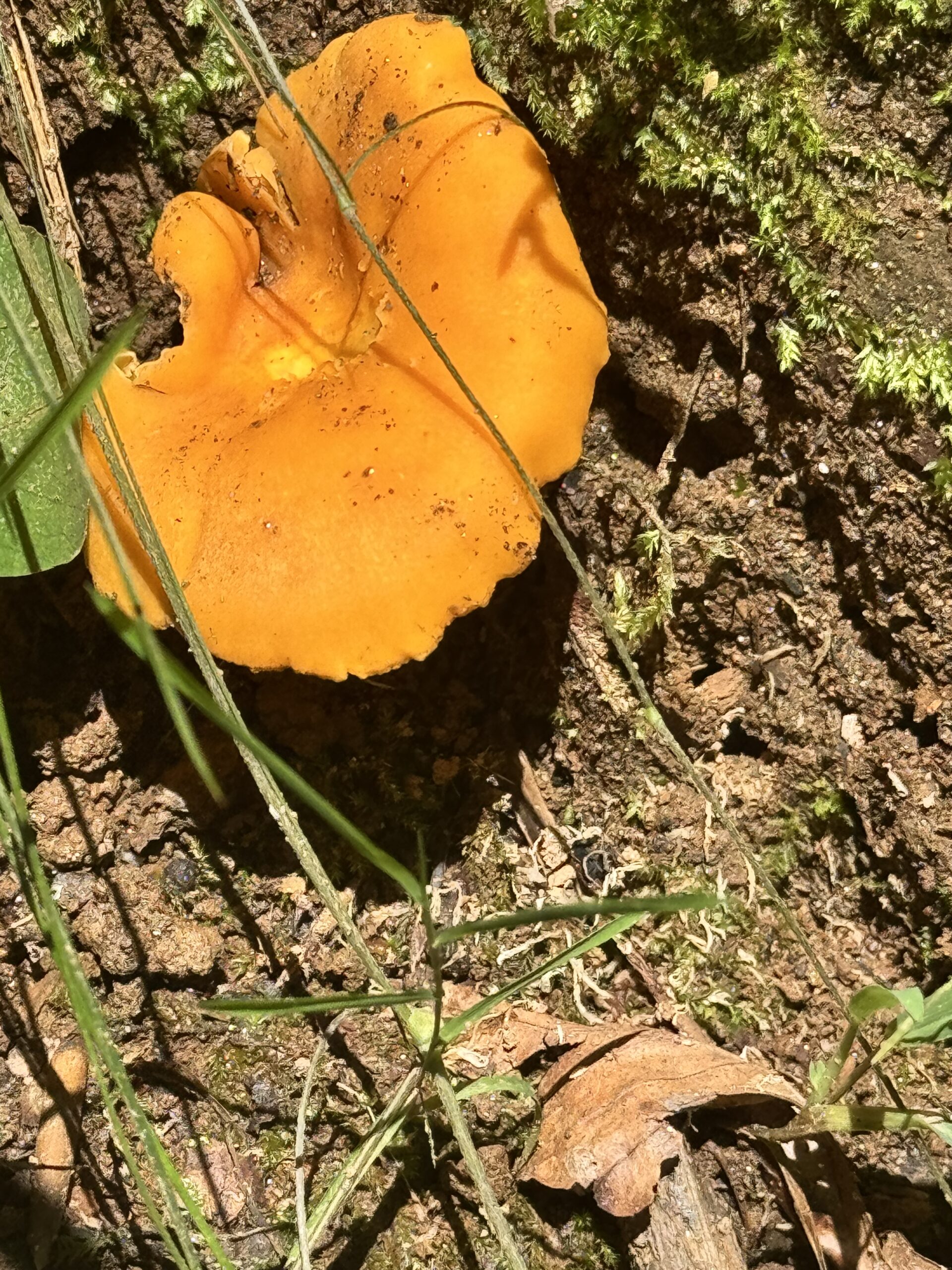
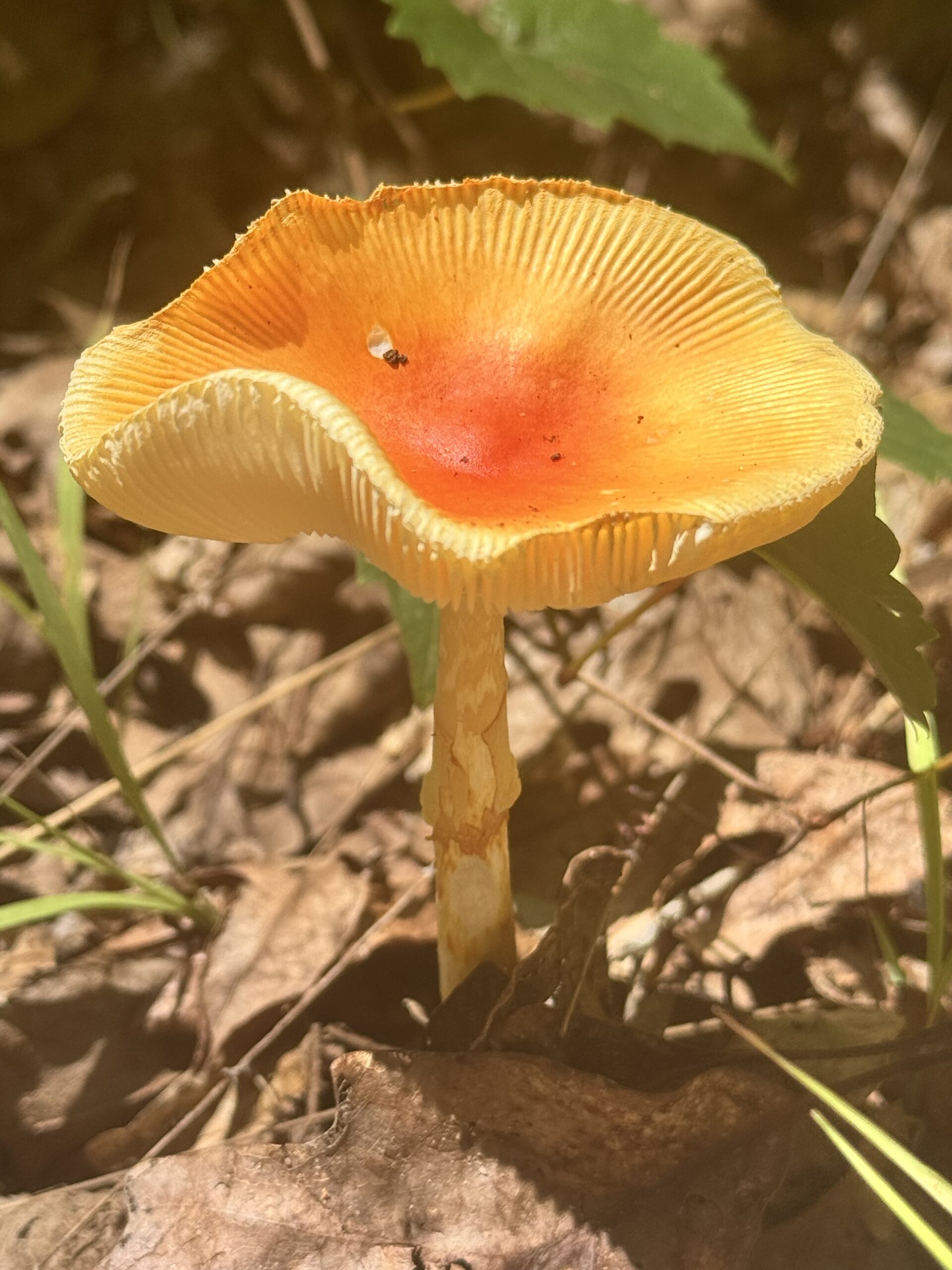
A few mushrooms stand out against the brown forest floor like brilliant orange mushrooms.
The specimens we photographed had orange to yellow-orange caps with pronounced gills running underneath. Several groups of mushrooms can look like this.
Chanterelles are among the best-known orange mushrooms of Southern Appalachian forests, but not every orange mushroom is a chanterelle. Jack-o’-lantern mushrooms, false chanterelles, and several Amanita species can produce colors that may fool an inexperienced observer.
One useful feature to examine is the underside.
True chanterelles generally have blunt folds or ridges rather than the thin, blade-like true gills found on many other mushrooms. That distinction can be difficult to judge from a photograph and is another reason hikers should never use color alone to identify an edible mushroom.
Whatever the exact species, an orange mushroom glowing in a patch of sunlight is one of the easiest fungi to spot along a Table Rock trail.
Pale Woodland Mushrooms
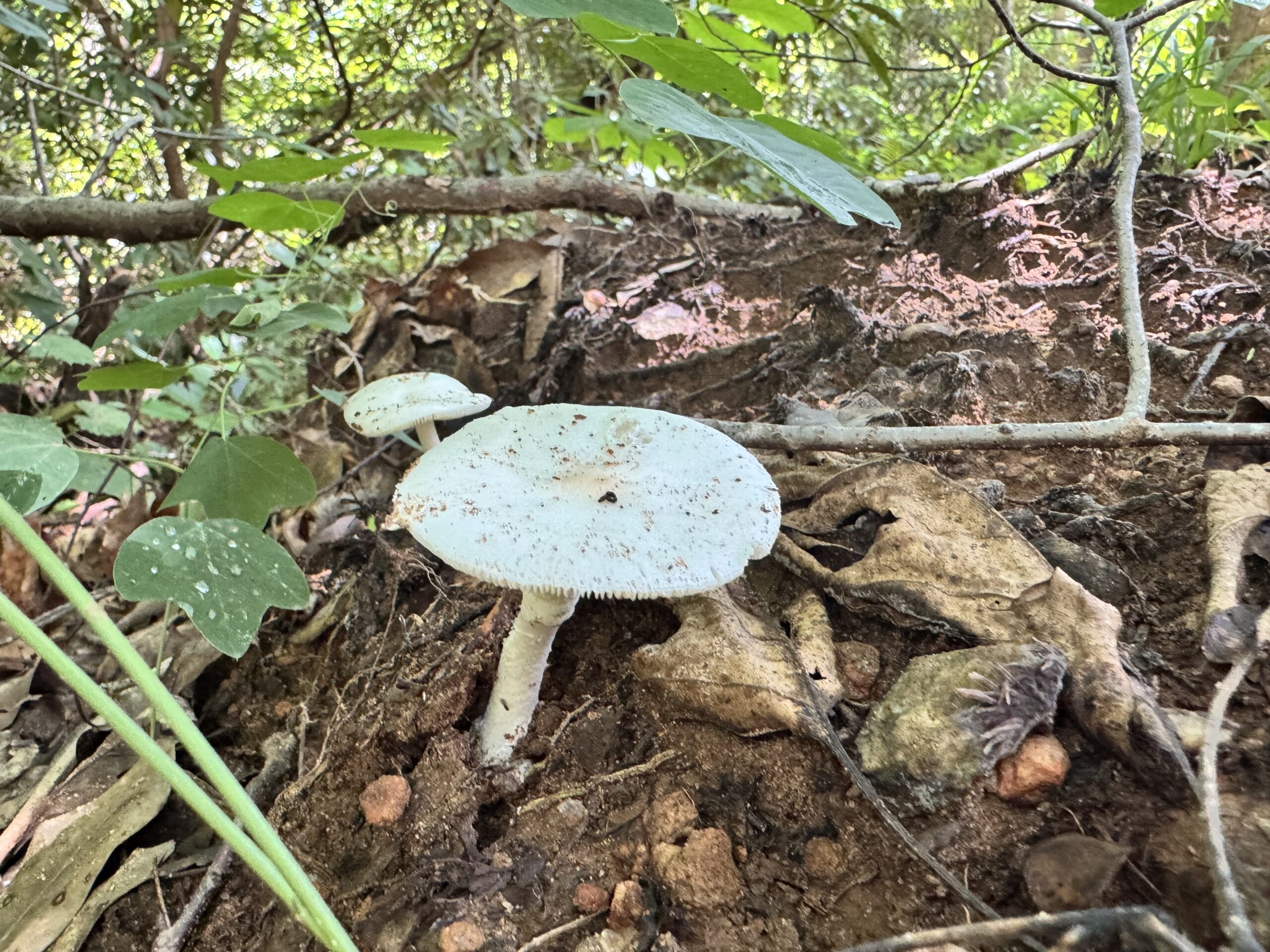
Not everything growing on the forest floor announces itself with bright colors.
White, cream, and pale yellow mushrooms are common sights in hardwood forests. They may belong to several different genera, including Russula, Lactarius, Amanita, and others.
The mushroom in IMG_5660 has a broad pale cap and stout stem. IMG_5663 shows another group of pale mushrooms growing nearby.
These are good examples of why mushroom identification can become surprisingly complicated. Cap color alone tells us very little.
Mycologists may examine the gills, stem, base, bruising reactions, odor, habitat, and even spore color before making an identification.
For hikers, simply noticing those differences can turn an ordinary walk through the woods into a scavenger hunt.
A Possible Milkcap or Russula

The broad cream-colored mushroom with the shallow depression in the center resembles mushrooms commonly encountered in the Russula and Lactarius groups.
These mushrooms are especially associated with woodland habitats because many form relationships with living trees.
Rather than simply feeding on dead material, their underground fungal networks can interact directly with tree roots. The fungus receives carbohydrates produced by the tree while helping the tree obtain water and nutrients from the soil.
What looks like a solitary mushroom on the surface can therefore be part of a much larger organism beneath your feet.
Turkey Tail and Other Shelf Fungi

Some of the easiest fungi to recognize around Table Rock aren’t shaped like the classic umbrella mushroom at all.
The layered, fan-shaped fungi growing from this fallen wood strongly resemble the group commonly known as turkey tails, named for the bands of brown, tan, gray, and cream that resemble the tail feathers of a wild turkey.
Turkey tail (Trametes versicolor) is a widespread wood-decaying fungus, although several similar shelf fungi can resemble it.
Unlike the mushrooms that suddenly emerge from the ground following rain, these tougher fungi can remain visible much longer.
They also reveal one of the most important jobs fungi perform at Table Rock.
They recycle the forest.
Fungi break down fallen branches, logs, and other organic material. Nutrients locked inside dead wood eventually return to the forest soil, where plants and trees can use them again.
Without fungi, the forest would look very different.
Why Table Rock Has So Many Mushrooms
Table Rock sits in an exceptionally productive environment for fungi.
The combination of Southern Appalachian forest, high humidity, abundant rainfall, shaded slopes, streams, leaf litter, and decaying wood creates numerous fungal habitats.
Different mushrooms also depend upon different conditions.
Some grow from buried wood. Others grow directly from logs. Some associate with particular trees. Still others appear rapidly following heavy summer rain.
That means the mushroom population you see during one visit may be completely different a week or two later.
When Is the Best Time to Look?
Summer into early fall can be an excellent time to look for mushrooms around Table Rock, particularly after periods of rain.
Warm temperatures and moist soil can trigger large numbers of fruiting bodies.
Morning can be especially enjoyable because mushrooms haven’t spent the entire day exposed to heat and drying sunlight.
You don’t need to hike deep into the backcountry either.
Look carefully around:
- fallen logs
- rotting stumps
- moist stream banks
- thick leaf litter
- moss-covered wood
- shaded hardwood forest
- the bases of mature trees
Once you start intentionally looking for mushrooms, you’ll probably notice far more than you expected.
The Mushroom Is Only the Part You See
One of the most interesting things about mushrooms is that the visible mushroom isn’t usually the entire organism.
Most of the fungus exists out of sight as a network of microscopic threads called mycelium.
The mushroom that suddenly appears above ground is the reproductive structure of that much larger organism.
A useful comparison is an apple tree.
The mushroom is somewhat like the apple. The larger fungal organism producing it remains hidden in the soil, wood, or other material.
That means a patch of forest containing only a few visible mushrooms may actually contain extensive fungal networks underneath the ground.
Don’t Pick Mushrooms Just to Identify Them
For most visitors, photography is the best way to enjoy Table Rock’s fungi.
If you’re trying to identify a mushroom, photograph several features rather than only the cap.
Try to photograph the top, underside, entire stem, base of the mushroom, and the surrounding habitat. A picture showing whether the mushroom was growing from soil, a living tree, or decaying wood can be extremely useful.
Clemson University notes that mushroom identification can be difficult enough that its Plant and Pest Diagnostic Clinic directs some mushroom-identification questions to a university mycologist.
That should tell you something about trusting a quick identification from an app.
A Forest Beneath the Forest
Most people come to Table Rock for the mountain views, waterfalls, creeks, and hiking trails.
The mushrooms offer another reason to slow down.
Some are smaller than a quarter. Others stand nearly a foot above the forest floor. Some blend perfectly into fallen leaves while brilliant orange species can practically glow in the sunlight.
And the mushrooms visible along the trail represent only a tiny portion of the fungal world operating throughout the forest.
The next time you hike Table Rock after a good summer rain, spend a little time looking down.
There may be an entire world growing beside the trail that you walked past the last time.
Quick Mushroom Safety
Never eat a wild mushroom unless its identity has been reliably established by someone with appropriate expertise. Several poisonous mushrooms can resemble edible species, and photographs or identification apps should not be considered sufficient for deciding whether a mushroom is safe to eat.
For identification questions in South Carolina, Clemson Cooperative Extension provides research-based resources and access to specialists statewide.


